.webp)
October 1, 2026
By Hatch
Share:
.svg)


Every Dimension X application is evaluated against the same four criteria: fit to challenge, novelty of technology, relevant team experience and business capability.
The panel is looking for more than an impressive technology. It needs to understand whether the solution addresses a real Home Team operational need, whether the team can deliver it and whether the proposed public safety use case makes sense for the business.
Before preparing your application, here is what you need to know about the Dimension X application criteria and selection process.
Dimension X is designed for deep-tech startups with a working prototype that has not yet been tested in the intended public safety operational environment.
These are the core eligibility requirements:
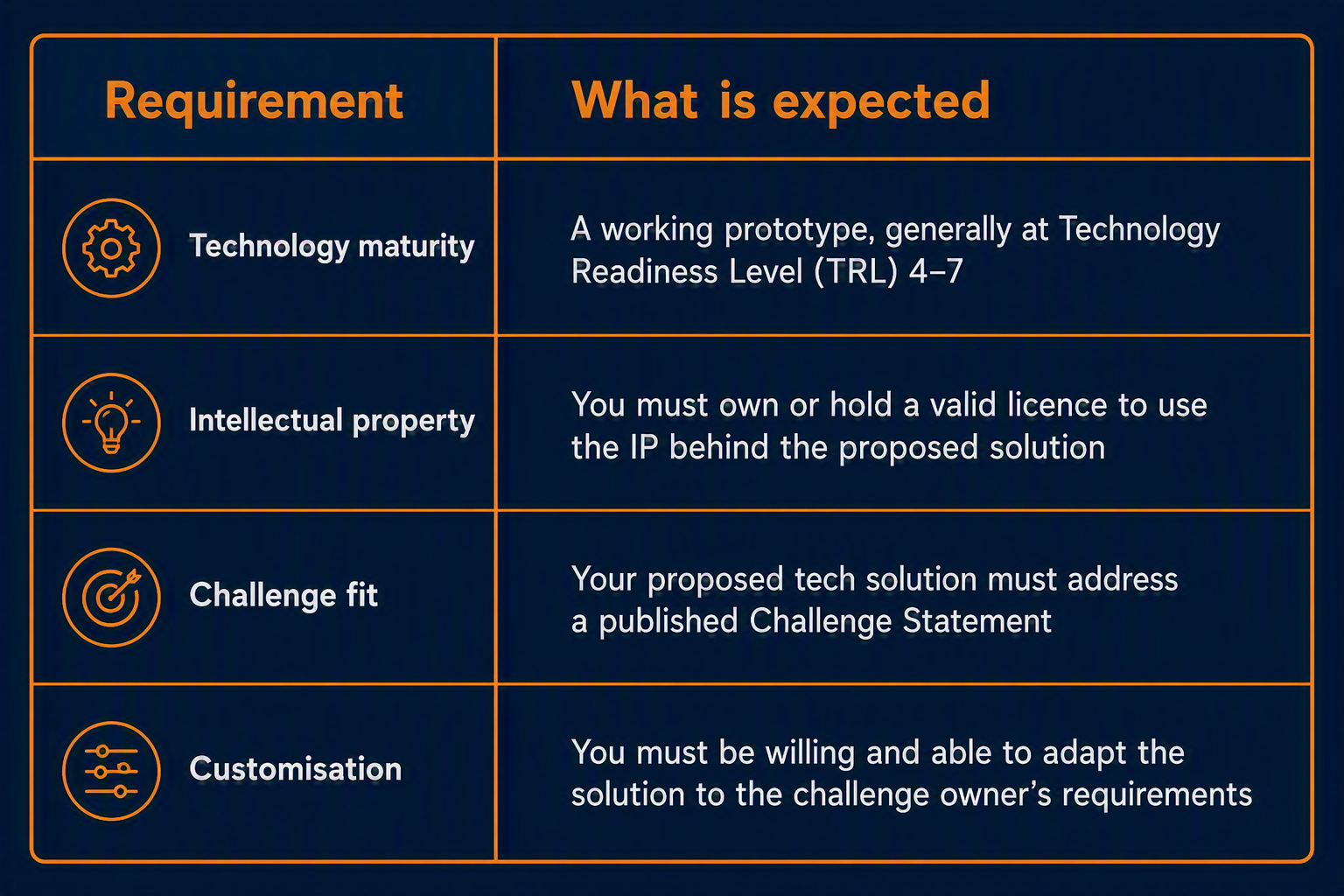
A concept without a working prototype does not meet the minimum technology-readiness requirement.
An existing or market-ready product may still qualify if you propose meaningful customisation for the Challenge Statement. A purely off-the-shelf product, offered without any adaptation, is not eligible.
Applications are reviewed by a panel comprising our team at Hatch, Home Team challenge owners and relevant technical experts from HTX, the Home Team Science and Technology Agency.
Each group brings a different perspective:
The four evaluation criteria are applied consistently across all Challenge Statements. There is no separate scoring framework for each technology domain.
Show that you understand the Challenge Statement as an operational problem, not simply as a broad technology category.
Connect specific capabilities in your product to the stated need. Explain where the technology already fits, where it will need to be adapted and what the resulting proof-of-concept could demonstrate.
Avoid submitting a generic company or product description that leaves the panel to work out the connection. If your technology can address more than one Challenge Statement, make the relevance to each selected challenge clear in your application.
Explain what is genuinely different about your approach.
That difference might lie in the underlying science, system architecture, performance, deployment method or ability to operate under conditions where existing alternatives struggle. Identify the relevant comparison and support your claims with available evidence.
Novelty does not mean adding fashionable terminology to the application. The panel needs to understand what new or differentiated capability your technology could bring to the challenge owner.
Identify the people who will be responsible for delivering the POC and explain why they are equipped to do it.
Relevant experience may come from developing the core technology, working in similar operating conditions, solving related technical problems, or bringing a product through previous stages of testing and validation.
Make the team’s responsibilities clear. The panel should be able to see that the necessary technical knowledge exists within the team and that the people responsible will be available during the four-month programme.
Explain why pursuing the public safety use case makes sense to your company.
The panel will consider whether there is a credible business behind the technology and whether the Dimension X project fits its direction. Your application should show that the team has the capacity and commitment to complete the programme, including the required development work and travel to Singapore.
The business model does not need to depend entirely on public safety. Technologies developed for other industries may be suitable if the team can demonstrate a credible route into this use case.
A useful final check is whether your application makes three things clear: what the technology can do now, what must be adapted and how your team can collaborate with the Champion to deliver that adaptation within four months.
Dimension X is country-agnostic and open to deep-tech startups across technology domains, funding stages and company sizes. Being based outside of Singapore, having a small team or not yet operating in public safety does not automatically put an applicant at a disadvantage.
Your technology also does not need to have been created specifically for public safety. What matters is whether it can be adapted to the selected operational challenge.
Conversely, having a mature, market-ready product is not an advantage if the proposed solution cannot be customised. Dimension X is intended to develop and validate a challenge-specific POC, not to showcase an unchanged commercial product.
For eligibility, travel and participation details, see the Dimension X FAQ for global applicants.
The confirmed Dimension X selection process is:
This process gives both the startup and challenge owner an opportunity to examine the potential fit before committing to POC development.
Read the realistic Dimension X application timeline for what to expect after submission, or explore the complete journey from Challenge Statement to on-site proof-of-concept.
Before submitting, check that your application answers these questions clearly:
If your answers to all five questions are clear, apply to Dimension X today.
Whether you are building breakthrough technologies or are seeking innovations for real-world challenges, as long as you are interested in advancing the future of public safety, we want to hear from you.

.webp)