.webp)
October 14, 2026
By Hatch
Share:
.svg)


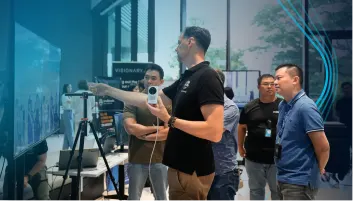
Last week, the Home Team Humanoid Robotics Centre (H2RC) opened at one-north with a clear goal for humanoid robots in public safety. By 2028, a humanoid robot should be working alongside Home Team officers in a real operational setting, performing defined tasks safely and reliably. Hazmat, prison, and forensic officers are among the first expected to work with them.
It is natural to picture that future as a hardware story: which robot is strongest, most agile or most human-like. But hardware is no longer what limits these machines. A robot's motors and joints set the limits of what it can physically do; what it actually manages to do within those limits depends on what it has learned, and what it learns comes from data.
That data is scarce.
Large language models were trained on decades of text that already existed online. Nothing comparable exists for the physical world: no vast public record of hands gripping, lifting, opening and searching. Robots have to be taught, one demonstration at a time, through humans guiding them remotely, or through practice in simulation.
This explains why so many robotics companies have converged on folding laundry. As Agility Robotics’ Chris Paxtor explained in IEEE Spectrum, folding laundry suits today’s learning methods. Imperfect demonstrations still work; a failed attempt is undone by picking up the cloth again, and there is little forceful contact to break things or complicate the data.
Public safety reverses almost every one of those conditions. A prison cell search involves force, clutter, and objects hidden on purpose. A post-blast scene is unstable and cannot be staged hundreds of times so a robot can practise. Mistakes cannot simply be undone, and the places where robots are most needed are exactly the ones where training data is hardest to collect.
So, the distance between a robot that impresses in a demo and one that can be trusted on duty depends on the infrastructure behind it: how operational data is captured, how simulation fills the gaps, and how systems are tested against failures that cannot safely be learned in the field.
Some of the most important companies in this emerging stack do not manufacture robots at all. Two companies that have come through Hatch illustrate the point.
General Robotics trains multi-modal foundation models that let humanoid robots carry out tasks. This is the layer where the shortage of physical data bites the hardest. The more a model can learn from each demonstration, the ess it depends on data that public safety settings will never supply in volume.
Blackshark.ai maps blast scenes in 3D and detects evidence within them. That turns one of the most hazardous places an officer enters, into structured, spatial data, which is what a robot would need before it could work there.
The more interesting question then is who builds the data, simulation and validation infrastructure that lets robots perform safely once the environment stops behaving like a demonstration.
Singapore has a chance to be where emerging systems meet difficult, operationally realistic problems before lives depend on them. The humanoid robots due to work alongside Home Team officers by 2028 may be the visible outcome. The more consequential capability could be the infrastructure built around them.
Building technology that could work in environments like these? Dimension X, Hatch's global open innovation challenge, is open for applications from 12 October to 6 November 2026. Selected start-ups develop proof-of-concepts with Home Team end users, against real operational requirements. Apply for Dimension X today!
Whether you are building breakthrough technologies or are seeking innovations for real-world challenges, as long as you are interested in advancing the future of public safety, we want to hear from you.

.webp)