.webp)
September 30, 2026
By Hatch
Share:
.svg)


Joining a startup accelerator programme is a familiar route for founders seeking funding and mentorship, with investor access often following once the company matures. However, it is not the only model available.
Open innovation programmes take a different approach. Instead of beginning with the startup’s general growth goals, they begin with a problem that an organisation needs to solve. Selected startups then work with challenge owners and end-users to adapt and validate their technology.
Understanding this distinction can help founders choose a programme based on what they need next: company-building support or evidence that their technology works in a specific operational environment.
A traditional startup accelerator is generally a fixed-term, cohort-based programme offering mentorship, business education, networking, and investor exposure. Many conclude with a Demo Day at which founders pitch to investors.
Programmes such as Y Combinator are widely recognised examples. Participating founders form a cohort and receive intensive support designed to help their companies improve their products, gain users, and prepare for further fundraising.
Many startup accelerators invest in participating companies in exchange for equity, although funding models vary. Accelerators may be generalist or focus on a particular industry, technology, or founder profile type.
The central objective is usually to accelerate the company. A traditional accelerator may therefore be a strong fit when a founder primarily needs business guidance, investor introductions and a peer network.
An open innovation programme such as Dimension X, sometimes described as an innovation challenge, starts with a problem identified by a corporation, government agency, or other organisation. External innovators are invited to propose technologies that could solve it.
A sophisticated technology isn't enough on its own; it must fit the operational need too. Startups respond to a challenge statement rather than pitching an open-ended business idea.
Successful applicants may receive funding, technical guidance, end-user access, and opportunities to develop and test a proof-of-concept. This structure is often described as a non-dilutive startup programme since founders typically don't give up equity, though it's worth examining each programme's terms covering equity, intellectual property, costs, and future commercial pathways.
The two models can both accelerate progress, but they begin from different points.
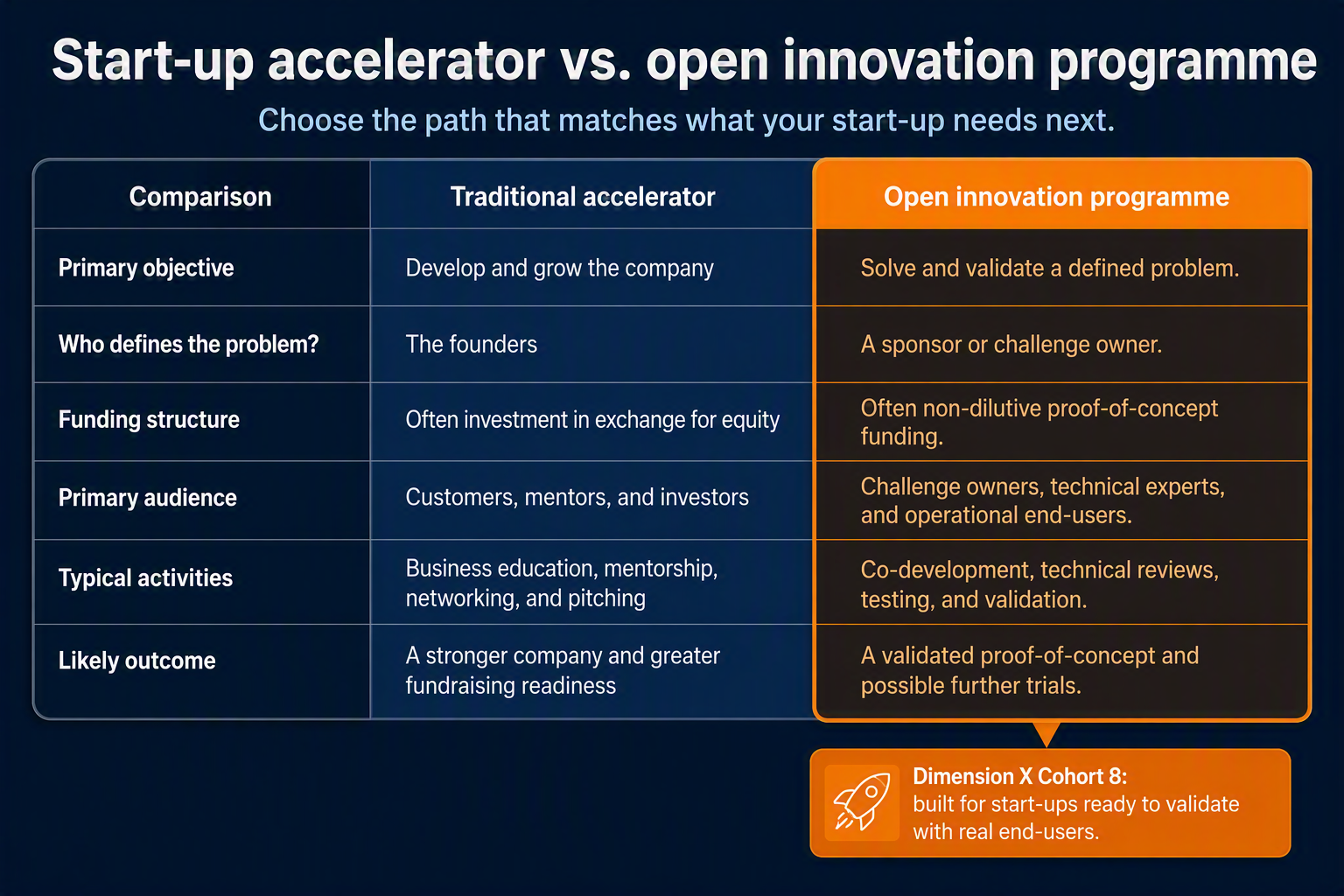
Neither model is universally better - the choice depends on the outcome a founder is most inclined to achieve at that point of their journey.
A startup accelerator can help answer, “How do we build and finance this company?” An open innovation programme is designed to help answer, “Can this technology solve this organisation’s problem under the conditions in which it will actually be used?”
Public safety is rarely a simple buyer–seller market. A technology may be tested by frontline officers, assessed by scientists or engineers, integrated by technical teams, and considered for procurement by a separate group of decision-makers.
This makes operational access especially valuable. A technology that performs well in a commercial or laboratory setting may need significant adaptation for hazardous, time-sensitive, security-sensitive, or physically demanding environments.
Working directly with end-users allows founders to test assumptions earlier. It can reveal requirements that may be difficult to identify from market research alone, from portability and battery life to interoperability with existing systems.
Dimension X is Hatch’s global open innovation programme for deep-tech startups, university spinouts, and scale-ups. It connects technology innovators across the world with challenge statements sourced from Singapore’s Home Team.
Dimension X begins with public safety challenges sourced from operational stakeholders. Every published challenge has an owner, known as a Champion, from HTX or a Home Team Department.
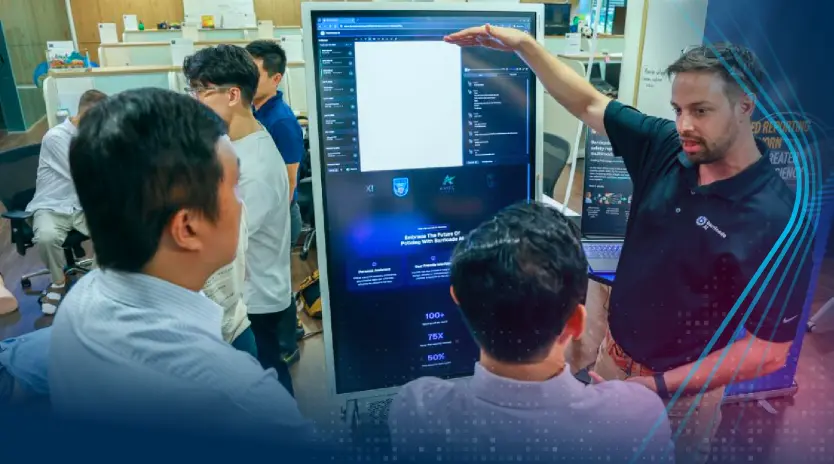
During the four-month proof-of-concept period, Champions work closely with selected startups through fortnightly touchpoints and joint technical reviews. HTX scientists and engineers provide technical guidance, while operational end-users contribute feedback during iterative testing. Startups based outside of Singapore do not need to relocate to Singapore for all four months, but participants must attend a one-week onboarding period at the start of the programme, and return for final onsite testing and Demo Day.
The value of this access to end-users can be seen in the work of previous cohorts. Before joining Dimension X, Manifold Tech primarily applied its 3D reconstruction technology to construction. Manifold Tech worked with a Singapore Civil Defence Force Champion to combine its handheld scanner with a robotic dog, building a prototype LiDAR-based system for fire-scene analysis. The collaboration helped the company identify a new public safety application for its technology, according to HTX.
Deeply provides another example. Its audio-intelligence technology was originally designed for indoor acoustic monitoring. Input from HTX’s Intel Programme Management Centre led the startup to develop portable, battery-powered sensors and refine its AI models for integration with existing public-safety systems. The resulting proof-of-concept was demonstrated during Dimension X Cohort 5, as documented by HTX.
Dimension X participants receive S$100,000 prize money for proof-of-concept development and required travel. Hatch does not retain equity or ownership of the solution, and participants retain full ownership of their intellectual property (IP).
At the end of the programme, startups conduct onsite tests and demonstrate their proof-of-concept to Champions and relevant stakeholders. Demo Day also introduces their work to public safety agencies, system integrators, and investors.
Successful validation does not guarantee a contract or deployment. However, strong proofs-of-concept may progress toward further development, operational trials, or potential procurement opportunities. Graduates also join the Hatch alumni network where they receive post-programme advisory support.
A traditional accelerator may be more suitable if your priority is developing your business model, expanding your founder network, meeting investors, or preparing to raise capital.
An open innovation programme may be more relevant if you already have a working technology and want to validate a use case with actual, credible end-users from the government sector.
Dimension X usually looks for deep-tech solutions with a Technology Readiness Levels 4 to 7. Strong applications combine technological novelty with operational relevance, in-house technical capability, and a business team prepared to commit to the programme. Advanced technology alone is insufficient if it does not address the selected challenge in a practical way.
Official applications open on October 5, 2026. If your technology could be adapted to address a public safety challenge, register your interest now to receive application updates. You can also read more about Hatch’s broader innovation process.
No. A traditional accelerator generally focuses on company growth and investment readiness. Open innovation focuses on solving and validating a sponsor-defined problem.
Yes — "innovation challenge" is another term for the same model. A startup accelerator vs. innovation challenge comparison comes down to the same core distinction covered above: accelerators focus on company growth, while innovation challenges focus on solving a sponsor's specific problem.
No. Participants receive S$100,000 prize money while retaining ownership of their intellectual property.
Yes. Dimension X is country-agnostic and open to global deep-tech startups from any domain. Selected teams must travel to Singapore for onboarding, onsite testing, and Demo Day.
No. Successful proofs-of-concept may be considered for further development, operational trials, or procurement opportunities, but participation does not guarantee a contract or deployment after the programme.
September 23, 2026

.webp)
July 28, 2026
June 19, 2026
Whether you are building breakthrough technologies or are seeking innovations for real-world challenges, as long as you are interested in advancing the future of public safety, we want to hear from you.

.webp)